
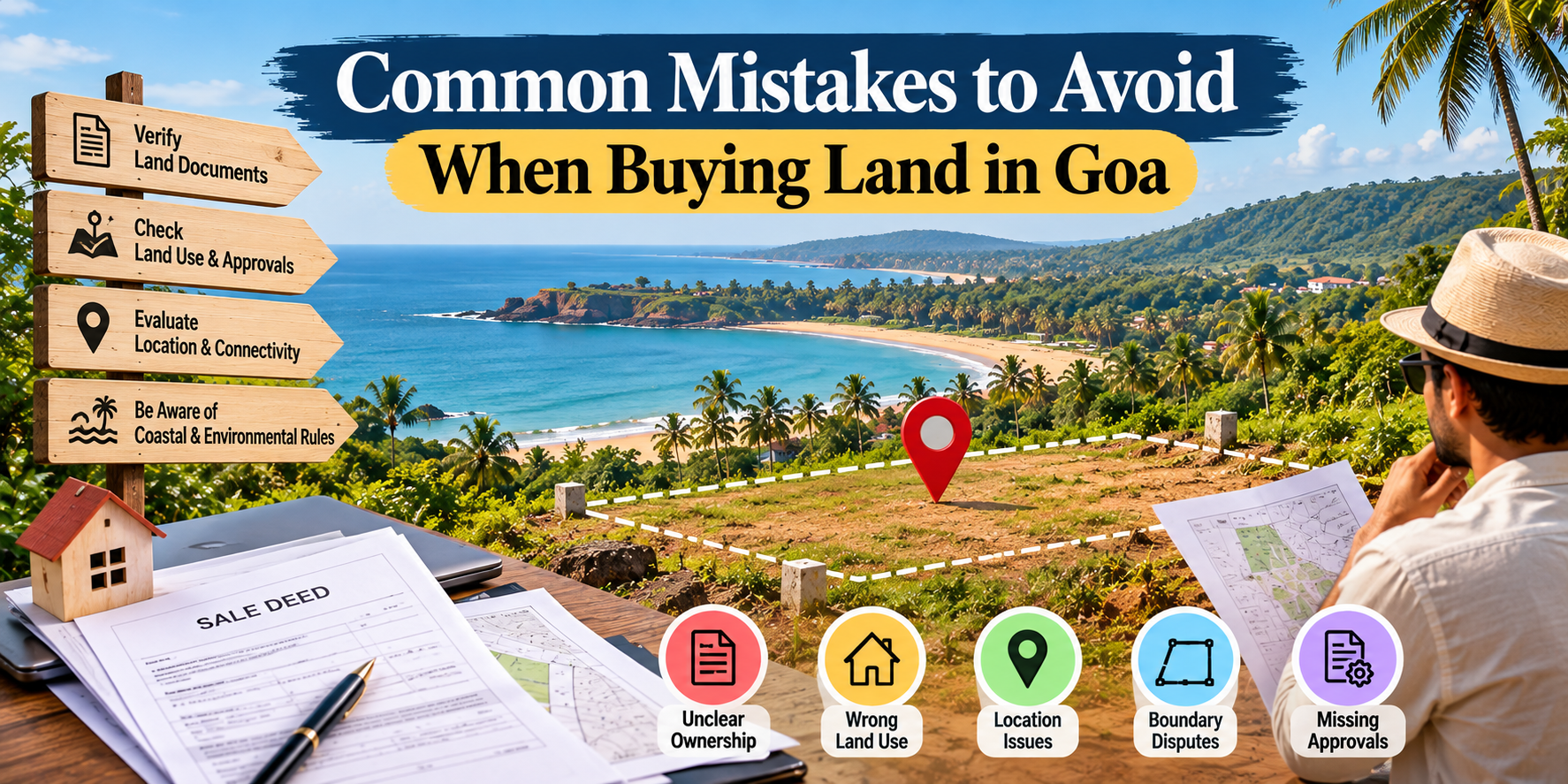
Buying land in Goa sounds like a dream for many people. Some imagine building a beautiful holiday home surrounded by greenery, while others see it as an opportunity to invest in a property that they can hold for years. With its beaches, peaceful villages, pleasant surroundings, and growing interest in real estate, Goa continues to attract buyers from different parts of India.
However, buying land is a major financial decision, and excitement can sometimes make people overlook important details.
A plot may look perfect during a site visit, the price may seem attractive, and the seller may promise that the area will develop soon. But what happens if the ownership documents are unclear, the land cannot legally be used for construction, or the actual plot does not match what was shown?
These are situations that can create unnecessary stress and financial problems.
If you are exploring plots in Goa, understanding the common mistakes buyers make can help you approach the purchase more carefully. Whether you are buying land for a future home, a holiday property, or long-term investment, knowing what to check before making a payment is extremely important.

Let’s look at some common mistakes you should avoid when buying land in Goa.
1. Not Verifying the Land Ownership Documents
One of the biggest mistakes buyers make is trusting the seller without properly checking the ownership documents.
Before purchasing any land, you must establish whether the seller has a clear legal right to sell it. A property may have an attractive location and a reasonable price, but unclear ownership can create serious complications later.
In Goa, land records and ownership history deserve particular attention. Some properties may have complicated inheritance arrangements, multiple legal heirs, old ownership records, or pending disputes.
Before proceeding, ask for relevant documents, which may include:
- Registered sale deed or other title documents.
- Previous ownership records and title chain.
- Form I and XIV, where applicable.
- Mutation records.
- Survey records and property identification details.
- Encumbrance-related records.
- Details of any pending litigation or claims.
The documents required will depend on the type and history of the property.
It is always advisable to get the complete title examined by an independent property lawyer familiar with Goa’s land laws.
Never assume that a person has the right to sell a property simply because they are in possession of the land.
2. Assuming Every Plot Can Be Used for Construction
This is another mistake that can become expensive.
Not every plot available for sale in Goa can automatically be used for constructing a residential house, villa, or commercial property.
Land may have different classifications and permitted uses. Some parcels may be agricultural, while others may fall under settlement zones or other categories under the applicable planning framework.
If your intention is to build a house, you must first understand whether the land legally permits your proposed use.
Before buying, check:
- The current land classification.
- Applicable zoning under the relevant Regional Plan or planning documents.
- Whether the intended construction is permitted.
- Whether land conversion or other approvals are required.
- Applicable restrictions under local planning and environmental regulations.
Do not depend only on the seller’s statement that construction is allowed.
For example, a buyer may purchase agricultural land assuming that a residential villa can be constructed immediately. Later, they may discover that additional permissions or changes in land use are necessary, or that construction is restricted altogether.
The correct approach is to verify the legal position before making a financial commitment.
3. Ignoring the Location and Surrounding Area
A beautiful plot does not always mean a suitable property.
Some buyers focus entirely on the land price and forget to examine the surrounding neighbourhood. This can affect their experience whether they intend to build a home, use the property as a holiday retreat, or hold it as an investment.
Goa has different types of locations, each offering a different lifestyle.
North Goa is often considered by buyers who prefer access to popular beaches, restaurants, cafés, and social activities. South Goa may appeal to those looking for a comparatively quieter environment and relaxed surroundings.
However, the experience can vary significantly from one village or neighbourhood to another.
Before choosing a location, consider:
- Distance from the nearest main road.
- Availability of grocery stores and daily necessities.
- Access to hospitals and other essential services.
- Nearby schools, if you plan to live there with your family.
- Traffic and noise levels.
- Surrounding development and vacant land.
- Road conditions during the monsoon.
Visit the location personally and spend enough time understanding the area.
A plot that looks attractive in photographs may feel very different when you visit it.
4. Not Checking the Survey Boundaries and Actual Plot Size
Another common mistake is assuming that the land area mentioned in an advertisement or discussed verbally is accurate.
Before buying plots in Goa, make sure the actual property boundaries and measurements match the available records and the proposed transaction.
A mismatch in survey details, boundaries, or area can create disputes between neighbouring owners or complications during registration and future development.
Ask for the relevant survey plan and have the property inspected by a qualified surveyor where necessary.
Pay attention to:
- Survey number and subdivision details.
- Actual plot dimensions.
- Physical boundary markings.
- Access to the property.
- Any overlap with neighbouring land.
- Differences between recorded and claimed measurements.
Do not finalise the purchase until you are satisfied that the land being offered is the same land described in the documents.
5. Overlooking Road Access and Right of Way
A plot may be located in a beautiful area, but if there is no legally established access to it, owning that land can become difficult.
Some buyers discover access-related problems only after purchasing the property.
For example, a seller may show a pathway that people have been using for years. However, that does not automatically mean the buyer has a legally enforceable right to use it.

Before purchasing, check whether the plot has proper legal access through a public road or a validly established right of way.
Also examine:
- Whether the approach road exists on the ground.
- Whether the access is reflected in relevant records, where applicable.
- Whether any easement or right-of-way arrangement is documented.
- Whether the road is wide enough for your intended use.
- Whether access remains available throughout the year.
This is particularly important if you plan to construct a house or transport building materials to the property.
A clear access arrangement should be verified before you proceed.
6. Buying Land Without Understanding Its Total Cost
Many buyers calculate their budget based only on the advertised land price.
However, the actual cost of purchasing land can be higher once additional expenses are included.
Depending on the transaction, you may need to account for:
- Stamp duty and registration charges.
- Legal consultation and title verification fees.
- Survey and measurement expenses.
- Applicable taxes and other statutory charges.
- Land conversion or approval-related expenses, where required.
- Brokerage or transaction charges, if applicable.
- Boundary wall and fencing costs.
- Future construction and maintenance expenses.
Ask the seller for a clear written breakdown of the amount payable.
You should also keep a financial buffer for unexpected expenses.
Planning the total budget in advance can help you avoid financial pressure after the purchase.
7. Believing Every Promise About Future Appreciation
Goa’s popularity as a holiday destination has attracted interest from property buyers. However, this does not mean that every plot will automatically increase in value.
One common mistake is purchasing land only because someone promises that prices will double in a short period.
Property appreciation depends on several factors, including location, legal status, connectivity, infrastructure, local demand, and the overall real estate market.
Before making an investment decision, ask yourself:
- Is the current price reasonable compared with similar properties?
- Is there actual infrastructure in the area?
- Are the ownership and land-use documents clear?
- Is there demand for properties in that location?
- Can you hold the land for several years if required?
- How easily could you sell the property in the future?
Avoid making decisions based on guaranteed-return claims.
Land can be a long-term asset, but it also involves risks, holding costs, and resale uncertainty.
A sensible purchase should make financial sense even without assuming unrealistic future appreciation.
8. Not Checking Environmental and Planning Restrictions
Goa is known for its natural surroundings, coastline, rivers, greenery, and environmentally sensitive areas.
Because of this, buyers should pay close attention to applicable environmental and planning restrictions.
Depending on the location, certain plots may be affected by regulations relating to coastal areas, wetlands, forests, no-development zones, or other protected areas.
For example, land falling within a regulated coastal zone may have restrictions on construction and development.
Before buying, check whether the property is affected by:
- Coastal Regulation Zone (CRZ) restrictions, where applicable.
- Wetland-related restrictions.
- Forest or protected-area regulations.
- Applicable environmental clearances.
- Local planning and development regulations.
These restrictions can significantly affect what you are legally allowed to do with the property.
If you are considering land close to beaches, rivers, or environmentally sensitive locations, independent legal and technical verification becomes even more important.
9. Trusting Only Photographs and Online Listings
Online property listings are useful for discovering available options. They help buyers compare locations, prices, plot sizes, and other basic details.
However, photographs cannot establish legal ownership, confirm land classification, or prove that a property is suitable for construction.
Sometimes, photographs may show a nearby road, open space, or development that is not actually part of the property being sold.

Before booking any plot:
- Visit the exact property.
- Match the location with the survey details.
- Check the actual road access.
- Confirm the dimensions and boundaries.
- Examine the surrounding development.
- Verify the seller’s claims independently.
If you are unable to visit immediately, request a detailed video walkthrough and copies of the relevant documents. Still, do not treat a virtual visit as a substitute for proper physical and legal verification.
10. Signing the Agreement Without Reading It Properly
The final paperwork is just as important as the property itself.
Some buyers are so focused on completing the purchase that they sign agreements without carefully reading the terms.
This can create problems later, especially if there are differences between what was promised and what is actually mentioned in the agreement.
Before signing, carefully review:
- Exact property description and survey details.
- Total purchase price.
- Payment schedule.
- Registration and transfer conditions.
- Possession terms.
- Refund and cancellation clauses.
- Seller’s obligations.
- Any representations regarding approvals or land use.
- Pending dues or other liabilities.
If the seller has made important promises about road access, utilities, approvals, or development, make sure these are properly documented where legally appropriate.
An independent lawyer should review the agreement before you sign or make a substantial payment.
11. Rushing Into a Purchase Because of Limited-Time Offers
Real estate sellers sometimes promote limited-period discounts or claim that only a few plots are left.
While genuine opportunities may exist, buyers should not allow sales pressure to replace proper research.
Buying land is a major financial decision. A few days spent verifying documents and inspecting the property are far better than spending years dealing with an avoidable dispute.
Take enough time to compare different properties, understand the legal position, and negotiate the terms.
If a seller is unwilling to provide relevant documents or discourages independent verification, treat that as a reason to be cautious.
A genuine property opportunity should be able to withstand reasonable questions.
Checklist Before Buying Land in Goa
Before finalising your purchase, go through this quick checklist:
- Verify the complete ownership and title history.
- Check Form I and XIV and other relevant land records.
- Confirm the land classification and permitted use.
- Examine applicable zoning and planning restrictions.
- Verify the survey number, boundaries, and plot dimensions.
- Confirm legal road access and right of way.
- Check environmental and coastal restrictions, where applicable.
- Visit the actual property.
- Calculate the total purchase cost.
- Review the sale agreement with an independent lawyer.
Completing these checks can help you understand the property better before committing your money.
Frequently Asked Questions (FAQs)
1. What should I check before buying land in Goa?
You should check ownership documents, title history, Form I and XIV, survey records, land classification, zoning, construction permissions, road access, environmental restrictions, and the total purchase cost.
2. Is it safe to buy plots in Goa?
Buying land in Goa can be a reasonable decision when the property has clear ownership, appropriate land-use status, legally established access, and properly verified documentation. Independent legal verification is strongly recommended.
3. Can I build a house on agricultural land in Goa?
Not automatically. Construction depends on the applicable land-use rules, planning regulations, and permissions. You should verify whether conversion or other approvals are required before purchasing.
4. What is Form I and XIV in Goa?
Form I and XIV is an important land record used in Goa’s revenue administration. It contains details relating to land and its occupants or cultivators. However, it should not be treated as conclusive proof of ownership. A complete title examination is necessary.
5. Should I visit a plot before purchasing it?
Yes. A physical visit helps you check the actual location, boundaries, road access, surrounding development, and ground conditions. It also allows you to compare the property with the information provided by the seller.
6. What are the risks of buying land near beaches in Goa?
Land near beaches may be subject to Coastal Regulation Zone restrictions and other planning or environmental regulations. Always verify the applicable restrictions and permitted development before purchasing.
7. Can land in Goa be a good long-term investment?
It may suit buyers who have a long-term holding plan and select a property after careful legal and financial evaluation. However, appreciation and resale are not guaranteed, and market conditions can change.
Conclusion
Buying land in Goa can be an exciting step, whether you are planning to build a holiday home, create a peaceful personal space, or explore a long-term real estate opportunity.
But the most important part of the purchase is not how beautiful the location looks or how attractive the price sounds. It is understanding exactly what you are buying.
From ownership documents and land classification to survey boundaries, road access, environmental restrictions, and the final agreement, every detail deserves attention.
When exploring plots in Goa, avoid rushing into a decision based on photographs, verbal promises, or expectations of quick appreciation. Take time to inspect the property, compare available options, and get the documents independently verified.
A carefully selected plot can give you greater confidence in your property decision and help you plan your future with fewer uncertainties.
At GoaPlot.in, you can explore Goa property opportunities and learn more about locations and land options before taking your next step.
The right property decision begins with the right information. Do your research, ask questions, and make your purchase with confidence.